Research and outcomes
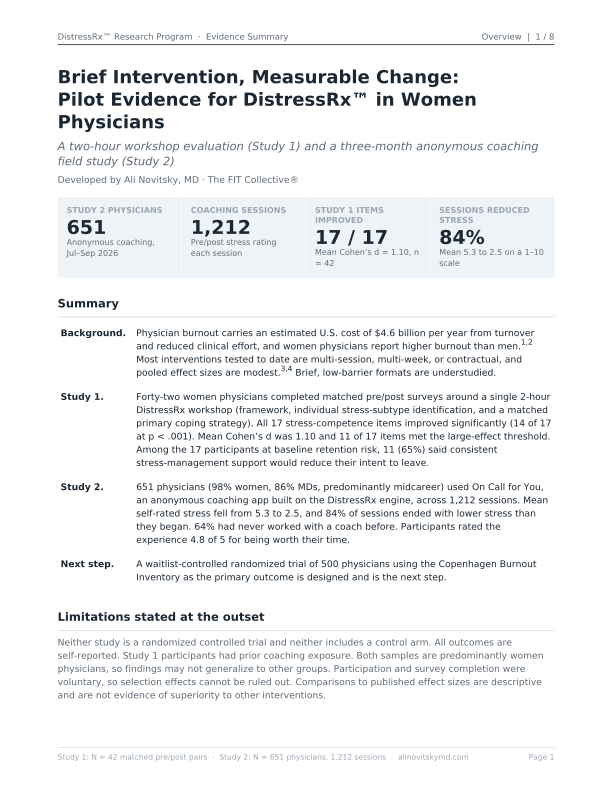
Brief Intervention, Measurable Change: Pilot Evidence for DistressRx™ in Women Physicians A two-hour workshop evaluation (Study 1) and a three-month anonymous coaching field study (Study 2) Developed by Ali Novitsky, MD · The FIT Collective® STUDY 2 PHYSICIANS 651 Anonymous coaching, Jul–Sep 2026 COACHING SESSIONS 1,212 Pre/post stress rating each session STUDY 1 ITEMS IMPROVED 17 / 17 Mean Cohen’s d = 1.10, n = 42 SESSIONS REDUCED STRESS 84% Mean 5.3 to 2.5 on a 1–10 scale Summary Background. Physician burnout carries an estimated U.S. cost of $4.6 billion per year from turnover and reduced clinical effort, and women physicians report higher burnout than men.1,2 Most interventions tested to date are multi-session, multi-week, or contractual, and pooled effect sizes are modest.3,4 Brief, low-barrier formats are understudied. Study 1. Forty-two women physicians completed matched pre/post surveys around a single 2-hour DistressRx workshop (framework, individual stress-subtype identification, and a matched primary coping strategy). All 17 stress-competence items improved significantly (14 of 17 at p < .001). Mean Cohen’s d was 1.10 and 11 of 17 items met the large-effect threshold. Among the 17 participants at baseline retention risk, 11 (65%) said consistent stress-management support would reduce their intent to leave. Study 2. 651 physicians (98% women, 86% MDs, predominantly midcareer) used On Call for You, an anonymous coaching app built on the DistressRx engine, across 1,212 sessions. Mean self-rated stress fell from 5.3 to 2.5, and 84% of sessions ended with lower stress than they began. 64% had never worked with a coach before. Participants rated the experience 4.8 of 5 for being worth their time. Next step. A waitlist-controlled randomized trial of 500 physicians using the Copenhagen Burnout Inventory as the primary outcome is designed and is the next step. Limitations stated at the outset Neither study is a randomized controlled trial and neither includes a control arm. All outcomes are self-reported. Study 1 participants had prior coaching exposure. Both samples are predominantly women physicians, so findings may not generalize to other groups. Participation and survey completion were voluntary, so selection effects cannot be ruled out. Comparisons to published effect sizes are descriptive and are not evidence of superiority to other interventions. DistressRx™ Research Program · Evidence Summary Overview | 1 / 8 Study 1: N = 42 matched pre/post pairs · Study 2: N = 651 physicians, 1,212 sessions · alinovitskymd.com Page 1
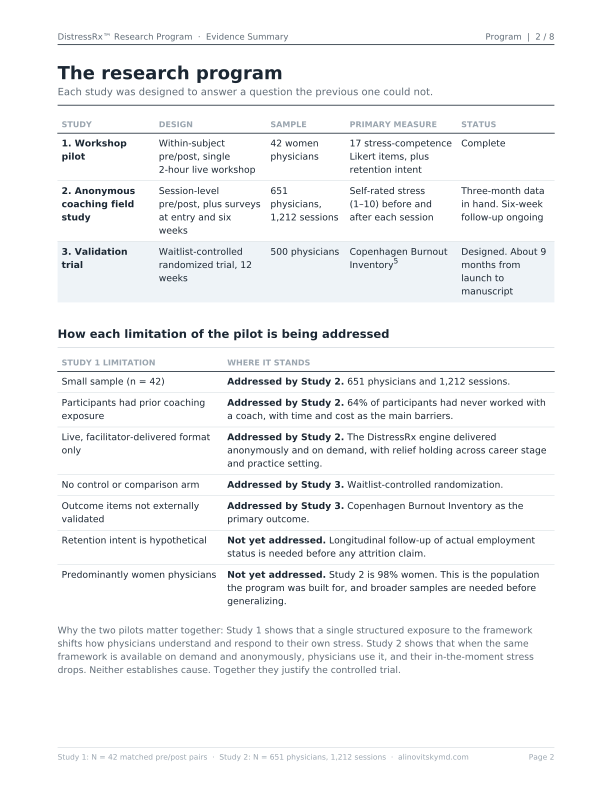
The research program Each study was designed to answer a question the previous one could not. STUDY DESIGN SAMPLE PRIMARY MEASURE STATUS 1. Workshop pilot Within-subject pre/post, single 2-hour live workshop 42 women physicians 17 stress-competence Likert items, plus retention intent Complete 2. Anonymous coaching field study Session-level pre/post, plus surveys at entry and six weeks 651 physicians, 1,212 sessions Self-rated stress (1–10) before and after each session Three-month data in hand. Six-week follow-up ongoing 3. Validation trial Waitlist-controlled randomized trial, 12 weeks 500 physicians Copenhagen Burnout Inventory5 Designed. About 9 months from launch to manuscript How each limitation of the pilot is being addressed STUDY 1 LIMITATION WHERE IT STANDS Small sample (n = 42) Addressed by Study 2. 651 physicians and 1,212 sessions. Participants had prior coaching exposure Addressed by Study 2. 64% of participants had never worked with a coach, with time and cost as the main barriers. Live, facilitator-delivered format only Addressed by Study 2. The DistressRx engine delivered anonymously and on demand, with relief holding across career stage and practice setting. No control or comparison arm Addressed by Study 3. Waitlist-controlled randomization. Outcome items not externally validated Addressed by Study 3. Copenhagen Burnout Inventory as the primary outcome. Retention intent is hypothetical Not yet addressed. Longitudinal follow-up of actual employment status is needed before any attrition claim. Predominantly women physicians Not yet addressed. Study 2 is 98% women. This is the population the program was built for, and broader samples are needed before generalizing. Why the two pilots matter together: Study 1 shows that a single structured exposure to the framework shifts how physicians understand and respond to their own stress. Study 2 shows that when the same framework is available on demand and anonymously, physicians use it, and their in-the-moment stress drops. Neither establishes cause. Together they justify the controlled trial. DistressRx™ Research Program · Evidence Summary Program | 2 / 8 Study 1: N = 42 matched pre/post pairs · Study 2: N = 651 physicians, 1,212 sessions · alinovitskymd.com Page 2
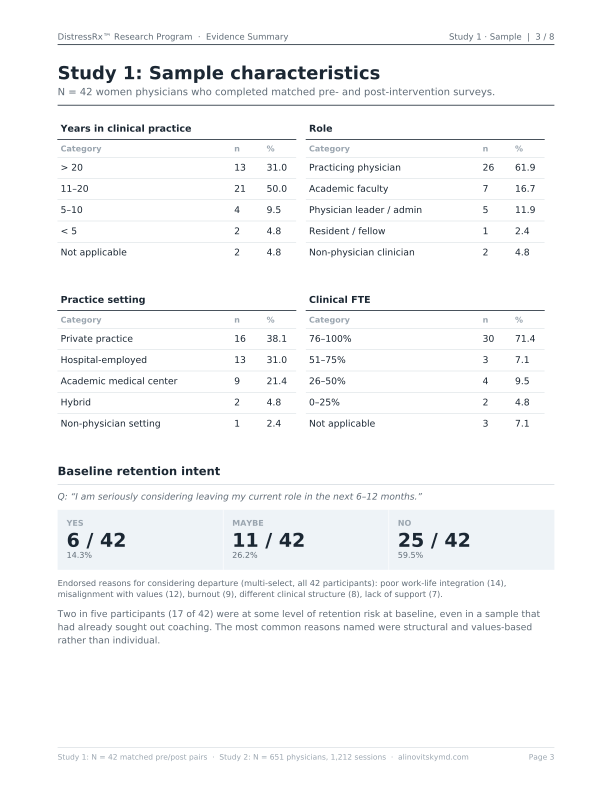
Study 1: Sample characteristics N = 42 women physicians who completed matched pre- and post-intervention surveys. Years in clinical practice Category n % > 20 13 31.0 11–20 21 50.0 5–10 4 9.5 < 5 2 4.8 Not applicable 2 4.8 Role Category n % Practicing physician 26 61.9 Academic faculty 7 16.7 Physician leader / admin 5 11.9 Resident / fellow 1 2.4 Non-physician clinician 2 4.8 Practice setting Category n % Private practice 16 38.1 Hospital-employed 13 31.0 Academic medical center 9 21.4 Hybrid 2 4.8 Non-physician setting 1 2.4 Clinical FTE Category n % 76–100% 30 71.4 51–75% 3 7.1 26–50% 4 9.5 0–25% 2 4.8 Not applicable 3 7.1 Baseline retention intent Q: “I am seriously considering leaving my current role in the next 6–12 months.” YES 6 / 42 14.3% MAYBE 11 / 42 26.2% NO 25 / 42 59.5% Endorsed reasons for considering departure (multi-select, all 42 participants): poor work-life integration (14), misalignment with values (12), burnout (9), different clinical structure (8), lack of support (7). Two in five participants (17 of 42) were at some level of retention risk at baseline, even in a sample that had already sought out coaching. The most common reasons named were structural and values-based rather than individual. DistressRx™ Research Program · Evidence Summary Study 1 · Sample | 3 / 8 Study 1: N = 42 matched pre/post pairs · Study 2: N = 651 physicians, 1,212 sessions · alinovitskymd.com Page 3
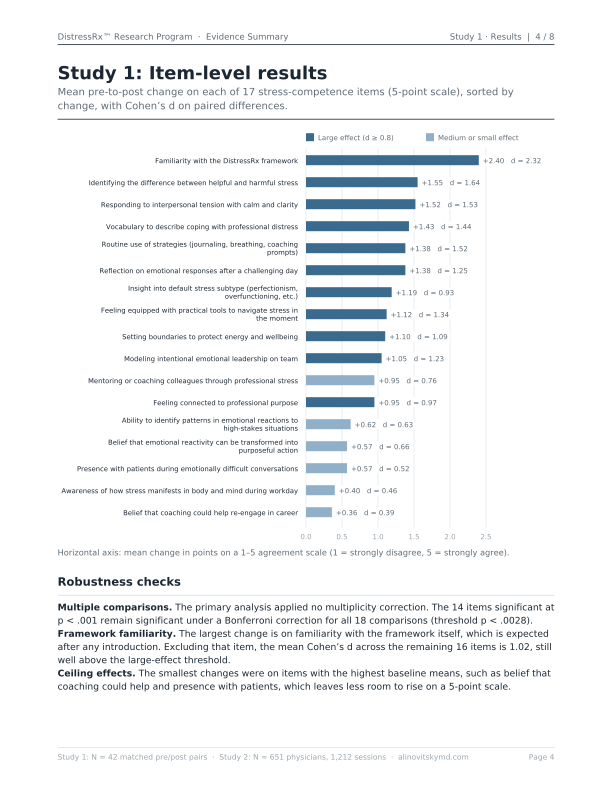
Study 1: Item-level results Mean pre-to-post change on each of 17 stress-competence items (5-point scale), sorted by change, with Cohen’s d on paired differences. 0.0 0.5 1.0 1.5 2.0 2.5 Familiarity with the DistressRx framework +2.40 d = 2.32 Identifying the difference between helpful and harmful stress +1.55 d = 1.64 Responding to interpersonal tension with calm and clarity +1.52 d = 1.53 Vocabulary to describe coping with professional distress +1.43 d = 1.44 Routine use of strategies (journaling, breathing, coaching prompts) +1.38 d = 1.52 Reflection on emotional responses after a challenging day +1.38 d = 1.25 Insight into default stress subtype (perfectionism, overfunctioning, etc.) +1.19 d = 0.93 Feeling equipped with practical tools to navigate stress in the moment +1.12 d = 1.34 Setting boundaries to protect energy and wellbeing +1.10 d = 1.09 Modeling intentional emotional leadership on team +1.05 d = 1.23 Mentoring or coaching colleagues through professional stress +0.95 d = 0.76 Feeling connected to professional purpose +0.95 d = 0.97 Ability to identify patterns in emotional reactions to high-stakes situations +0.62 d = 0.63 Belief that emotional reactivity can be transformed into purposeful action +0.57 d = 0.66 Presence with patients during emotionally difficult conversations +0.57 d = 0.52 Awareness of how stress manifests in body and mind during workday +0.40 d = 0.46 Belief that coaching could help re-engage in career +0.36 d = 0.39 Large effect (d ≥ 0.8) Medium or small effect Horizontal axis: mean change in points on a 1–5 agreement scale (1 = strongly disagree, 5 = strongly agree). Robustness checks Multiple comparisons. The primary analysis applied no multiplicity correction. The 14 items significant at p < .001 remain significant under a Bonferroni correction for all 18 comparisons (threshold p < .0028). Framework familiarity. The largest change is on familiarity with the framework itself, which is expected after any introduction. Excluding that item, the mean Cohen’s d across the remaining 16 items is 1.02, still well above the large-effect threshold. Ceiling effects. The smallest changes were on items with the highest baseline means, such as belief that coaching could help and presence with patients, which leaves less room to rise on a 5-point scale. DistressRx™ Research Program · Evidence Summary Study 1 · Results | 4 / 8 Study 1: N = 42 matched pre/post pairs · Study 2: N = 651 physicians, 1,212 sessions · alinovitskymd.com Page 4
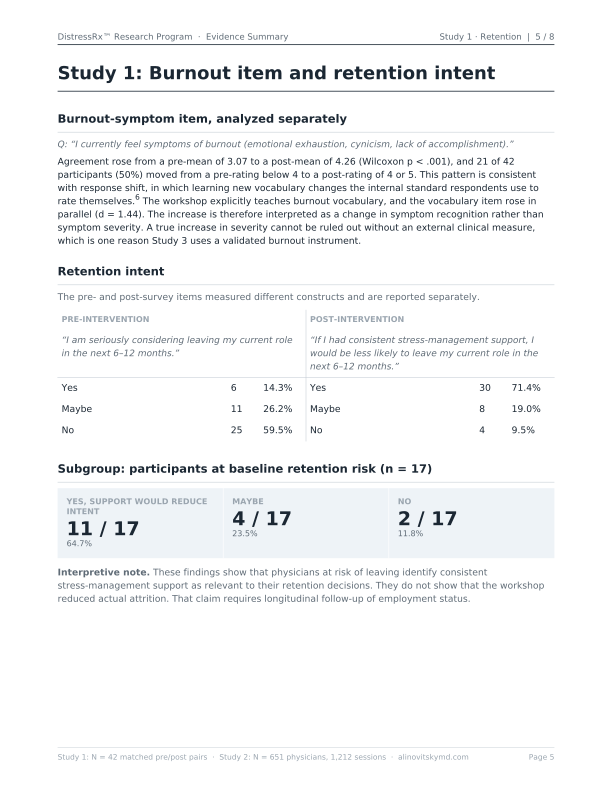
Study 1: Burnout item and retention intent Burnout-symptom item, analyzed separately Q: “I currently feel symptoms of burnout (emotional exhaustion, cynicism, lack of accomplishment).” Agreement rose from a pre-mean of 3.07 to a post-mean of 4.26 (Wilcoxon p < .001), and 21 of 42 participants (50%) moved from a pre-rating below 4 to a post-rating of 4 or 5. This pattern is consistent with response shift, in which learning new vocabulary changes the internal standard respondents use to rate themselves.6 The workshop explicitly teaches burnout vocabulary, and the vocabulary item rose in parallel (d = 1.44). The increase is therefore interpreted as a change in symptom recognition rather than symptom severity. A true increase in severity cannot be ruled out without an external clinical measure, which is one reason Study 3 uses a validated burnout instrument. Retention intent The pre- and post-survey items measured different constructs and are reported separately. PRE-INTERVENTION POST-INTERVENTION “I am seriously considering leaving my current role in the next 6–12 months.” “If I had consistent stress-management support, I would be less likely to leave my current role in the next 6–12 months.” Yes 6 14.3% Yes 30 71.4% Maybe 11 26.2% Maybe 8 19.0% No 25 59.5% No 4 9.5% Subgroup: participants at baseline retention risk (n = 17) YES, SUPPORT WOULD REDUCE INTENT 11 / 17 64.7% MAYBE 4 / 17 23.5% NO 2 / 17 11.8% Interpretive note. These findings show that physicians at risk of leaving identify consistent stress-management support as relevant to their retention decisions. They do not show that the workshop reduced actual attrition. That claim requires longitudinal follow-up of employment status. DistressRx™ Research Program · Evidence Summary Study 1 · Retention | 5 / 8 Study 1: N = 42 matched pre/post pairs · Study 2: N = 651 physicians, 1,212 sessions · alinovitskymd.com Page 5
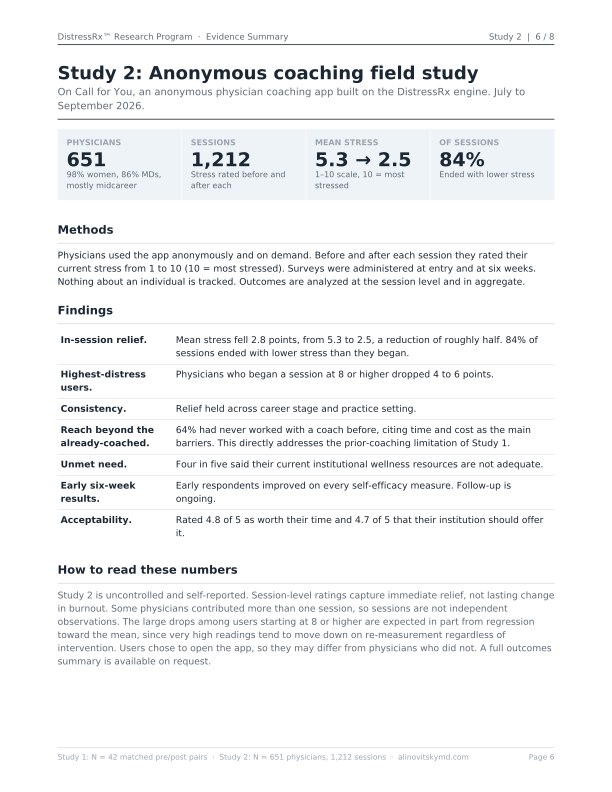
Study 2: Anonymous coaching field study On Call for You, an anonymous physician coaching app built on the DistressRx engine. July to September 2026. PHYSICIANS 651 98% women, 86% MDs, mostly midcareer SESSIONS 1,212 Stress rated before and after each MEAN STRESS 5.3 → 2.5 1–10 scale, 10 = most stressed OF SESSIONS 84% Ended with lower stress Methods Physicians used the app anonymously and on demand. Before and after each session they rated their current stress from 1 to 10 (10 = most stressed). Surveys were administered at entry and at six weeks. Nothing about an individual is tracked. Outcomes are analyzed at the session level and in aggregate. Findings In-session relief. Mean stress fell 2.8 points, from 5.3 to 2.5, a reduction of roughly half. 84% of sessions ended with lower stress than they began. Highest-distress users. Physicians who began a session at 8 or higher dropped 4 to 6 points. Consistency. Relief held across career stage and practice setting. Reach beyond the already-coached. 64% had never worked with a coach before, citing time and cost as the main barriers. This directly addresses the prior-coaching limitation of Study 1. Unmet need. Four in five said their current institutional wellness resources are not adequate. Early six-week results. Early respondents improved on every self-efficacy measure. Follow-up is ongoing. Acceptability. Rated 4.8 of 5 as worth their time and 4.7 of 5 that their institution should offer it. How to read these numbers Study 2 is uncontrolled and self-reported. Session-level ratings capture immediate relief, not lasting change in burnout. Some physicians contributed more than one session, so sessions are not independent observations. The large drops among users starting at 8 or higher are expected in part from regression toward the mean, since very high readings tend to move down on re-measurement regardless of intervention. Users chose to open the app, so they may differ from physicians who did not. A full outcomes summary is available on request. DistressRx™ Research Program · Evidence Summary Study 2 | 6 / 8 Study 1: N = 42 matched pre/post pairs · Study 2: N = 651 physicians, 1,212 sessions · alinovitskymd.com Page 6
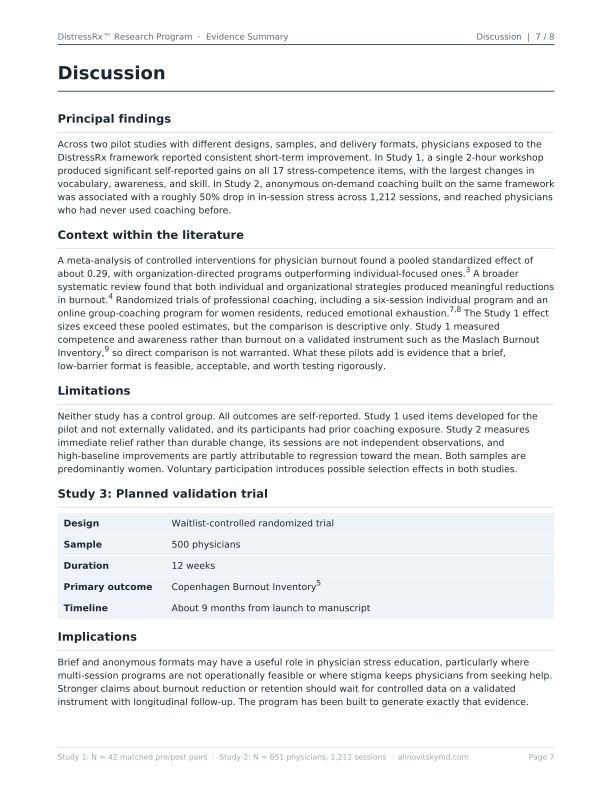
Discussion Principal findings Across two pilot studies with different designs, samples, and delivery formats, physicians exposed to the DistressRx framework reported consistent short-term improvement. In Study 1, a single 2-hour workshop produced significant self-reported gains on all 17 stress-competence items, with the largest changes in vocabulary, awareness, and skill. In Study 2, anonymous on-demand coaching built on the same framework was associated with a roughly 50% drop in in-session stress across 1,212 sessions, and reached physicians who had never used coaching before. Context within the literature A meta-analysis of controlled interventions for physician burnout found a pooled standardized effect of about 0.29, with organization-directed programs outperforming individual-focused ones.3 A broader systematic review found that both individual and organizational strategies produced meaningful reductions in burnout.4 Randomized trials of professional coaching, including a six-session individual program and an online group-coaching program for women residents, reduced emotional exhaustion.7,8 The Study 1 effect sizes exceed these pooled estimates, but the comparison is descriptive only. Study 1 measured competence and awareness rather than burnout on a validated instrument such as the Maslach Burnout Inventory,9 so direct comparison is not warranted. What these pilots add is evidence that a brief, low-barrier format is feasible, acceptable, and worth testing rigorously. Limitations Neither study has a control group. All outcomes are self-reported. Study 1 used items developed for the pilot and not externally validated, and its participants had prior coaching exposure. Study 2 measures immediate relief rather than durable change, its sessions are not independent observations, and high-baseline improvements are partly attributable to regression toward the mean. Both samples are predominantly women. Voluntary participation introduces possible selection effects in both studies. Study 3: Planned validation trial Design Waitlist-controlled randomized trial Sample 500 physicians Duration 12 weeks Primary outcome Copenhagen Burnout Inventory5 Timeline About 9 months from launch to manuscript Implications Brief and anonymous formats may have a useful role in physician stress education, particularly where multi-session programs are not operationally feasible or where stigma keeps physicians from seeking help. Stronger claims about burnout reduction or retention should wait for controlled data on a validated instrument with longitudinal follow-up. The program has been built to generate exactly that evidence. DistressRx™ Research Program · Evidence Summary Discussion | 7 / 8 Study 1: N = 42 matched pre/post pairs · Study 2: N = 651 physicians, 1,212 sessions · alinovitskymd.com Page 7
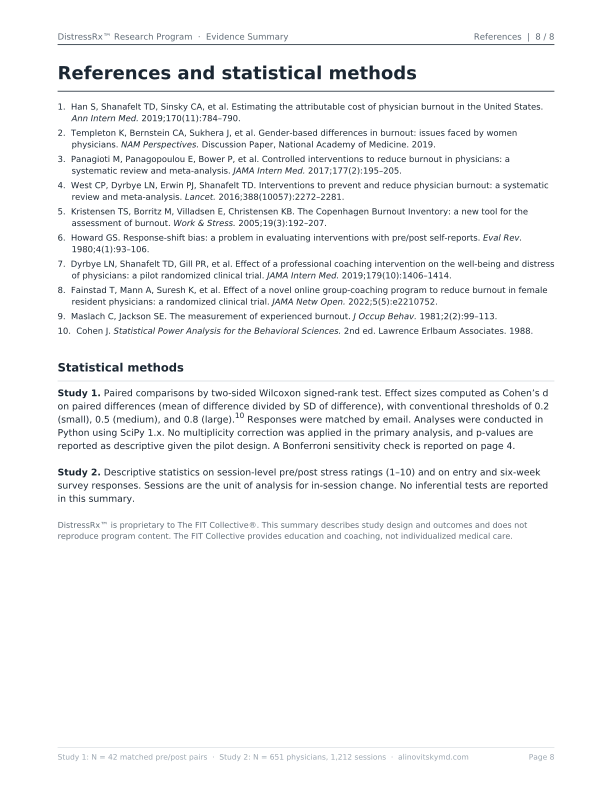
References and statistical methods 1. Han S, Shanafelt TD, Sinsky CA, et al. Estimating the attributable cost of physician burnout in the United States. Ann Intern Med. 2019;170(11):784–790. 2. Templeton K, Bernstein CA, Sukhera J, et al. Gender-based differences in burnout: issues faced by women physicians. NAM Perspectives. Discussion Paper, National Academy of Medicine. 2019. 3. Panagioti M, Panagopoulou E, Bower P, et al. Controlled interventions to reduce burnout in physicians: a systematic review and meta-analysis. JAMA Intern Med. 2017;177(2):195–205. 4. West CP, Dyrbye LN, Erwin PJ, Shanafelt TD. Interventions to prevent and reduce physician burnout: a systematic review and meta-analysis. Lancet. 2016;388(10057):2272–2281. 5. Kristensen TS, Borritz M, Villadsen E, Christensen KB. The Copenhagen Burnout Inventory: a new tool for the assessment of burnout. Work & Stress. 2005;19(3):192–207. 6. Howard GS. Response-shift bias: a problem in evaluating interventions with pre/post self-reports. Eval Rev. 1980;4(1):93–106. 7. Dyrbye LN, Shanafelt TD, Gill PR, et al. Effect of a professional coaching intervention on the well-being and distress of physicians: a pilot randomized clinical trial. JAMA Intern Med. 2019;179(10):1406–1414. 8. Fainstad T, Mann A, Suresh K, et al. Effect of a novel online group-coaching program to reduce burnout in female resident physicians: a randomized clinical trial. JAMA Netw Open. 2022;5(5):e2210752. 9. Maslach C, Jackson SE. The measurement of experienced burnout. J Occup Behav. 1981;2(2):99–113. 10. Cohen J. Statistical Power Analysis for the Behavioral Sciences. 2nd ed. Lawrence Erlbaum Associates. 1988. Statistical methods Study 1. Paired comparisons by two-sided Wilcoxon signed-rank test. Effect sizes computed as Cohen’s d on paired differences (mean of difference divided by SD of difference), with conventional thresholds of 0.2 (small), 0.5 (medium), and 0.8 (large).10 Responses were matched by email. Analyses were conducted in Python using SciPy 1.x. No multiplicity correction was applied in the primary analysis, and p-values are reported as descriptive given the pilot design. A Bonferroni sensitivity check is reported on page 4. Study 2. Descriptive statistics on session-level pre/post stress ratings (1–10) and on entry and six-week survey responses. Sessions are the unit of analysis for in-session change. No inferential tests are reported in this summary. DistressRx™ is proprietary to The FIT Collective®. This summary describes study design and outcomes and does not reproduce program content. The FIT Collective provides education and coaching, not individualized medical care. DistressRx™ Research Program · Evidence Summary References | 8 / 8 Study 1: N = 42 matched pre/post pairs · Study 2: N = 651 physicians, 1,212 sessions · alinovitskymd.com Page 8